★•.•´¯`•.•★Campground Reviews★•.•´¯`•.•★

click above link to visit our campground reviews
Showing posts with label Virginia. Show all posts

Saturday, May 5, 2012

Historic Fredericksburg Virginia

Boyhood home of George Washington and the site of crucial Civil War Battles Fredericksburg is one interesting place to hang out & visit. There are trolley tours  or horse drawn carriages to go site seeing in town but we chose to drive a car & walk around the historic areas.

The first place we went to was Mary Washington's house ~ Mary mother of George...

In 1772, George Washington purchased a house from Michael Robinson in Fredericksburg, Virginia for his mother. Mary Ball Washington spent her last seventeen years in this comfortable home. The white frame house sits on the corner of Charles and Lewis Streets and was in walking distance to Kenmore, home of Mary's daughter Betty Fielding Lewis. Also to her other son's, Charles, house which is now called Rising Sun Tavern which is what it was turned into after he sold it.  You can also tour that.
Tradition has it that, during the Revolution, General Lafayette found Mrs. Washington in her garden attending her favorite hobby. The President-to-be came to this home to receive his mother's blessing before attending his inauguration in 1789.
In 1891, the house was scheduled to be disassembled for travel to the Chicago World's Fair for display. However it was saved and the house underwent a restoration and was opened to the public. A mirror, Mrs. Washington called her "best dressing glass" and other possessions are on view in the house.
We take our everyday living for granted and don't even realize it until we visit places like Mary Washington's home and hear how they lived hundreds of years ago.  It was while we were here that they told us that back in the 1700's they took baths maybe 3 times a year and washed their hair only about twice.  I could hardly believe it and my head started to itch just thinking about that.

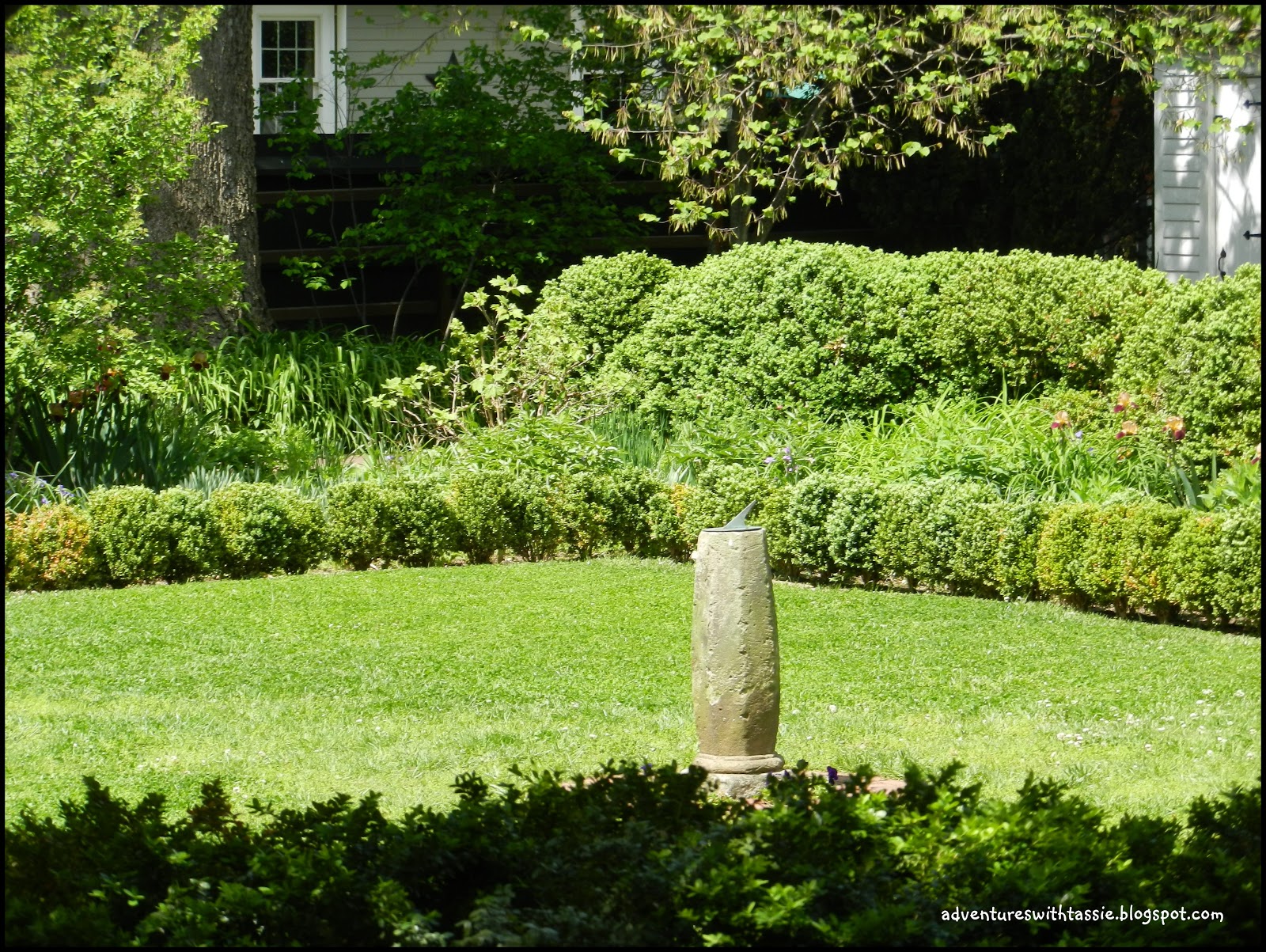
Her sundial still tracks the time of day in the garden.


Here are some other things that made me think hmmmmm ~ Glad I was born when I was.  They didn't washed their plates & silverware they just wiped them off after they were done eating.  They wealthier people always took their own utensils with them when they went to dinner at someone elses home.  They also told us that is why when they got sick it was one of the reasons it spread so fast throughout the lands.  Between bathing, washing your hair, wearing the same clothes by letting them air out and using dishes that were not washed ~ by the time I left there I was a little yukked out to say the least!  LOL LOL

After we visited here we went to Rising Sun Tavern which was once owned by Charles Washington.  What a fun and interesting tour this was. As soon as you walk in you are transported in time and treated like a guest from the late 1700's.  Here you will learn how a tavern operated during those times and learn a lot of interesting sayings that you have heard before but never know how they got started.  You’ll be greeted by a wench who is there to get you settled, show you around and attend to your needs. Please remember that this is the only proper tavern for 50 miles so be respectful.

Ladies, please leave all your literature (except the Bible) in your suitcases, as they are not welcome here. Gentleman, please enjoy yourselves but not too much as we will be getting you on a stagecoach in the wee hours of the morn.
This house, built by the younger brother of George Washington, was a popular stop for many, including John Marshall, James Madison, Thomas Jefferson, George Mason, and John Paul Jones, among others, during the American Revolutionary War.  It was the site of George Washington's "great reception" after the Battle of Yorktown. It was also the site of the first meeting of the Virginia Chapter of the Society of Cincinnati in 1783. The property was sold to Larkin Smith in 1791 and turned into a tavern.


There were several other places we visited throughout the day ~ Mary Washington's grave & Memorial, A Confederate Cemetery, A Masonic Cemetery and many old historic buildings and homes.  It was a fun day indeed...


Have Fun, Travel Safe & Stay Healthy!!!

Friday, May 4, 2012

Thomas "Stonewall" Jackson

While in Fredericksburg we made our way to the Chancellorsville Battlefield.  This is where Stonewall Jackson was wounded and soon after died from complications "pneumonia".  Some say that he was run down from battles and between that, being wounded and the dampness he contacted the pneumonia.  Even though he loss his arm he would have survived the wound he got from friendly fire.  We visited the battlefield and there we saw where he got shot and where they finally got him off his horse ~ then we followed the trail from Chancellorsville to the train station where he died.  They still have the house with the original bed that he died in.  Learning the story of Jackson was very interesting for not only was he a General but also a loving husband and a new father of a 6 month old child. As with all battlefields this was very sad as we imagined the time and all the men who lost their lives.

Here is a little history on the events:
Thomas Jonathan "Stonewall" Jackson  was a Confederate General during the American Civil War, and one of the best-known Confederate commanders after General Robert E. Lee. His military career includes the Valley Campaign of 1862 and his service as a corps commander in the Army of Northern Virginia under Robert E. Lee. Confederate pickets accidentally shot him at the Battle of Chancellorsville on May 2, 1863; the general survived with the loss of an arm to amputation. However, he died of complications from pneumonia eight days later. His death was a severe setback for the Confederacy, affecting not only its military prospects, but also the morale of its army and of the general public. Jackson in death became an icon of Southern heroism and commitment, joining Lee in the pantheon of the "Lost Cause"

Chancellorsville Battlefield
Military historians consider Jackson to be one of the most gifted tactical commanders in the nation's history. His Valley Campaign and his envelopment of the Union Army right wing at Chancellorsville are studied worldwide even today as examples of innovative and bold leadership. He excelled as well in other battles: the First Battle of Bull Run (where he received his famous nickname "Stonewall"), Second Bull Run, Antietam, and Fredericksburg. Jackson was not universally successful as a commander, however, as displayed by his weak and confused efforts during the Seven Days Battles around Richmond in 1862

House Jackson died in

Losing Stonewall Jackson during the battle at Chancellorsville took a tole on the Confederate armies and his wife, who never remarried. We enjoyed the history and following the trail from the battle to the Guinea Train Depot where Jackson finally died from pneumonia.


Actual bed that Jackson died from pneumonia in


This area around Fredericksburg is full of history not only from the Civil War but the Colonial times too.  It is a great place to visit for a week or so.  You should come and stay for a while in this historic town


Have Fun, Travel Safe & Stay Healthy!!!

Thursday, May 3, 2012

The Sunken Road

We arrived in Fredericksburg early in the afternoon and pulled into the Fredericksburg KOA. To see a complete review of this campground click here.  As soon as we set up we headed out to visit Fredericksburg National Military Park Visitor Center.  There are a lot of Civil War battlefields in this National Military Park and it was here that I found out that 60% of the Civil War battles happened in Virginia. Here are a couple of the stories that I found interesting and wanted to share with you.

The Story of Sunken Road
1863 image of Sunken Road
photo taken in 1863
Sunken Road/Stone Wall
Same photo taken 2012
On May 3, 1863, this photo was taken during a second Battle of Fredericksburg which was part of the Chancellorsville Campaign

The other photo was taken from about the same spot as the historic view above. In the early 19th century a stone wall was built along this three block section. During the first Battle of Fredericksburg on December 13, 1862, the wall protected Southern soldiers fortunate to stand behind it. Behind the wall, only around 300 Confederate soldiers were shot. By contrast in front of the wall, approximately 8,000 Union soldiers were hit. After the war, much of the wall was removed. A portion was rebuilt in the 1930's and in 2004.
Sunken Road


Map of Sunken Road/Marye's Heights walking tour
Map of Sunken Road/Marye's Heights walking Tour
The Story of General Thomas R.R. Cobb
General Thomas Cobb
Cobb Monument


Early in the battle, General Thomas R.R. Cobb was mortally wounded within sight of the house where his mother was born. As the primary writer of the Confederate Constitution, Cobb was the best known soldier killed in the Battle of Fredericksburg. For more information on Cobb's life and death.

Several years after the war, Rufus B. Merchant, a former member of Cobb's Legion, suggested that the state of Georgia purchase Martha Stephens's house along the Sunken Road and create a small park in memory of Cobb's Georgia Brigade, the centerpiece of which would be a monument to Cobb. Merchant found some support, but the Cobb family disapproved fearing that a public fundraising effort might "have the semblance of ostentation, and perhaps excite jealousies...." Instead the family erected a small monument, shown here, in 1888 on or very near the spot where Cobb was mortally wounded.
The Story of Martha Stephens
Martha Stephens Marker
Martha Stephens (also spelled Stevens) lived along the Sunken Road. She had several common law husbands and interchangeably used three different last names, apparently a reflection of her mood at the moment. She also owned the adjacent Innis House, one of her other last names. Martha's social status rose considerably in the aftermath of the Battle of Fredericksburg because of her help to Confederate soldiers. This monument was erected to her by the United Daughters of the Confederacy and dedicated on December 18, 1917. The inscriptions states "Here Lived Mrs. Martha Stephens Friend of the Confederate Soldier, 1861-1865 U.D.C.
Stephens House
House pre Civil War
The Stephens House was built prior to the war and lived in by Edward Stephens and his common law wife, Martha Stephens who interchangeably used three last names in written records. During the Battle of Fredericksburg it was used as a headquarters by General Thomas Cobb and General Joseph Kershaw.
House 2012
The Innis House was built about 1861 on property owned by Martha Stephens. In 1861 it was lived in by John Innis, one of Martha's common law husbands. Today it is owned by the National Park Service and is open on special occasions such as during the anniversary of the battle and on the Saturday evening of the Memorial Day weekend.
Interior of Innis House
The Innis House was lived in until the 1970's. After the house was sold to the park, restoration work returned the house to its 1862 appearance. Work crews removed modern layers of wood and wall paper revealing hundreds of bullet holes like the ones seen here.
19th century view of Sunken Road/Stone Wall
Sunken Road and Stone Wall
This 19th century view shows the Sunken Road, Stone Wall and Innis House


This modern view is from about the same place as the photo above. Note the stone walls on both sides of the road which are original. Also note that the road is sunken in this section. The wall beyond the Innis House was rebuilt in 2004


Richard KirklandThe Story of Rowland Kirkland
Richard Rowland Kirkland, 2nd South Carolina Regiment
On December 14, the day after the major assaults, thousands of injured and suffering Union soldiers in front of the stone wall cried for help. Richard Rowland Kirkland, a 19 year old sergeant from South Carolina, voluntarily risked his life to take water and provide assistance to the suffering Union soldiers. He later became famous as the Angel of Marye's Heights.
These are just a few of the many stories we read or heard about on this afternoons outing and the walking tour was a nice leisurely stroll throughout this part of the
Fredericksburg National Military Park.
Drum used in the Civil War
Have Fun, Travel Safe & Stay Healthy!!!

Friday, April 27, 2012

Confederate Whitehouse & Monument Drive

While in Richmond we decided to go see the Confederate White House and Museum.  The museum is 3 floors of artifacts and information all about the Confederate's side of the war and then there is the Confederate White House which was a counterpart to the White House in Washington DC as far as what took place there but on the Confederate side.


The Museum of the Confederacy is located in Richmond, Virginia. The museum includes the former White House of the Confederacy and maintains a comprehensive collection of artifacts, manuscripts and photographs from the Confederate States of America and the American Civil War (1861-1865).


The White House of the Confederacy is a gray stuccoed neoclassical mansion built in 1818 by John Brockenbrough, who was president of the Bank of Virginia. Designed by Robert Mills, Brockenbrough’s private residence was built in early nineteenth century Richmond's affluent Shockoe Hill neighborhood (later known as the Court End District), and was two blocks north of the Virginia State Capitol. Among his neighbors were U.S. Chief Justice John Marshall, Aaron Burr, defense attorney John Wickham, and future U.S. Senator Benjamin Watkins Leigh.
Sold by the Brockenbrough family in 1844, the house passed through a succession of wealthy families throughout the antebellum period, including U.S. Congressman and future Confederate Secretary of War James Seddon. Just prior to the American Civil War, Lewis Dabney Crenshaw purchased the house and added a third floor. He sold the home to the City of Richmond, which in turn rented it to the Confederate government as its Executive Mansion.


Jefferson Davis, his wife Varina, and their children moved into the house in August 1861, and lived there for the remainder of the war. Davis suffered from recurring bouts with malaria, facial neuralgia, cataracts (in his left eye), unhealed wounds from the Mexican War (bone spurs in his heel), and insomnia. Consequently, President Davis maintained an at-home office on the second floor of the White House. This was an unusual practice at that time – the West Wing of the White House in Washington, DC, was not added until the Theodore Roosevelt Administration. President Davis’ personal secretary, Colonel Burton Harrison, also lived in the house.
The Davis family was quite young during their stay at the White House of the Confederacy. When they moved in the First Family consisted of the President and First Lady, six year-old Margaret, four year-old Jefferson Davis, Jr., and two year-old Joseph. The two youngest Davis children, William and Varina Anne (“Winnie”), were born in the White House, in 1861 and 1864, respectively. Among their neighborhood playmates was George Smith Patton, whose father commanded the 22nd Virginia Infantry, and whose son commanded the U.S. Third Army in World War Two. Joseph Davis died in the spring of 1864, after a 15-foot fall from the railing on the White House’s east portico. Mrs. Davis’ mother and sister were occasional visitors to the Confederate executive mansion.

interior lighting formerly gas, now electric

The house was abandoned during the evacuation of Richmond on April 2, 1865. Within twelve hours, soldiers from Major General Godfrey Weitzel’s XVIII Corps seized the former Confederate White House, intact. President Abraham Lincoln, who was in nearby City Point (now Hopewell, Virginia), traveled up the James River to tour the captured city, and visited Davis' former residence for about three hours - although the President only toured the first floor, feeling it would be improper to visit the more private second floor of another man's home. Admiral David Porter accompanied Lincoln during the visit to the former Confederate executive mansion. They held a number of meetings with local officials in the White House. Among them was Confederate Brigadier General Joseph Reid Anderson, who owned the Tredegar Iron Works.
During Reconstruction, the White House of the Confederacy served as the headquarters for Military District Number One (Virginia), and was occasionally used as the residence of the commanding officer of the Department of Virginia. Among those who served there were Major Generals Edward O.C. Ord, Alfred Terry, Henry Halleck, and Edward R.S. Canby. When Reconstruction ended in Virginia, (October 1870), the City of Richmond retook possession of the house, and subsequently used it as Richmond Central School, one of the first public schools in postwar Richmond.When the City announced its plans to demolish the building to make way for a more modern school building in 1890, the Confederate Memorial Literary Society was formed with the sole purpose of saving the White House from destruction.

After touring the Confederate White House we took a ride down Monument Drive where we saw the huge statues of Jefferson Davis,  not to mention the gorgeous era homes along the way too.  Monument Avenue, is a premier example of the Grand American Avenue city planning style. The first monument, a statue of Robert E. Lee was erected in 1890. Between 1900 and 1925, Monument Avenue exploded with architecturally significant houses, churches and apartment buildings. A tree-lined grassy mall divides the east and west-bound sides of the street and is punctuated by statues memorializing Virginian Confederate participants of the Civil War Robert E. Lee, J.E.B. Stuart, Jefferson Davis, Thomas "Stonewall" Jackson.
George Washington
 
Robert E. Lee
George Washington @ Virginia Capital
These monuments are huge and so impressive and are a great tribute to men who fought in a horrible war
Thomas "Stonewall" Jackson
Jefferson Davis
Jefferson Davis


There is a ton of history in the Richmond area and I highly recommend visiting here ~ spending at least a week if you love the history of the Civil War.

"JEB" Stuart
There are not to many BIG rig RV Parks in this are so we stayed at a KOA ~ we are not big fans of KOAs because we think they are pricey for what they offer.  That being said this one was not too bad.  Click here to see a complete review of the park.
Have Fun, Travel Safe & Stay Healthy!!!

Tuesday, April 24, 2012

Historic Beginnings.... the Virginia Triangle

We stayed in the Williamsburg area at American Heritage RV Park for 5 days so that we could explore Colonial National Historic Park and explore it we did.  This park included Yorktown & Jamestown ~ they both took us each an entire day to see.  We went out everyday and checked out all the history we could in this historic triangle area which also included Historic Williamsburg (not a National park but definitely full of historic beginnings for this country. We had one of the best Chinese Buffets we have ever ate at while here also.  Peking Palace was exceptionally clean and the food was fabulous.  Our first day out was spent visiting Yorktown:
Yorktowne, Virginia:
There's plenty to do in this charming riverside town. There are many small cafes, shops and restaurants that you can spend an entire day exploring. There are also many historically-significant points of interest to learn about that revolve around the Civil War and the American Revolution.
Yorktown Battlefield and Visitor Center is a national park where tours include battlefield earthworks, Washington’s Headquarters, Washington’s tent and Surrender Field. You can step back in time walking through the battlefield, past the Yorktown Victory Monument, and then past Moore House where surrender terms were negotiated. Yorktown Victory Center is a living history museum of the American Revolution tell the stories of men, women and children who lived during the war. Outside, a recreated military encampment depicts life in the military including the use of medicine in Colonial times.
At a simulated 1780s farm site, you can learn about growing crops, preserving and preparing food and turning flax and wool into cloth.


There is both a driving tour a a walking tour of the Battlefield ~ while there we had one of the best Park Rangers (Linda) giving us the story of the American Revolution that happened there.  We also did the driving tour through the battlefield.


Jamestown, Virginia ~ America's Birthplace 1607: 
Star your experience at the Historic Jamestown visitor center, where exhibits and walking tours with Park Rangers provide background on Jamestown’s beginnings. Walk through the town site to see the original church tower dating to the 1640s and the reconstructed foundations of some of the earliest buildings. At the museum pier, see the replicas of the 3 ships that transported the original colonists to Jamestown in 1607.  An Powhatans Indian Village is recreates to see how they lived and farmed at the time the English arrived.  Hear about the actual meeting and relationship between Captain John Smith and Pocahontas. You can also see and learn how the settlers lived at the recreated Fort James Settlement.  This was a fascinating day and we really enjoyed stepping back in history.  


We also visited the Jamestown Rediscovery excavation, where archaeologists are uncovering the remains of the original James Fort and learning how the environment and climate in 1607 affected the settlers. At the Dale House, see a modest exhibit of artifacts, watch conservators working on the latest finds from the James Fort and browse the museum store books and memorabilia of Jamestown archaeology. This was another day full of discovery and learning about our country's beginnings.  Hope you enjoyed the slide show. I couldn't figure out the new blogger so I put slide shows in...

Colonial Williamsburg:
This is where it all began ~ our separation from England. The likes of George Washington, Patrick Henry, Thomas Jefferson all were here to make the major decisions in our futures as Americans.  It is a great place to visit but make sure you allow at least 3 days to explore and enjoy this historic town.  Some of it is actual buildings and some are rebuilt but all are full of history.  There are many re-inactors that wander the streets and reenact daily life amongst the colonist.  It all started here on July 12th, 1776...  Have dinner at one of the historic Inns ~ the food was GREAT!!!


We really enjoyed our time in this area and being lovers of history it was a learning experience... Now we are moving on the Richmond Virginia where we will explore one of our country most trying and sadist time ~ the Civil War. A war where our we fought each other....

To see a complete review of American Heritage RV Park click here.
Have Fun, Travel Safe & Stay Healthy!!!

Photobucket

Get your mamogram & check up today... Early detection saved my life....

breast_cancer_survivor

My Awards