





While visiting Savannah we took some time to go visit Fort Pulaski, a Civil War fort named after the Polish Revolutionary War Hero, Count Casimir Pulaski, who died in the Siege of Savannah in 1779. At the outbreak of the Civil War, Fort Pulaski was a federal (or Union) fort. Confederate forces seized the fort one week after the first shots were fired at Fort Sumter, and it became a Confederate Fort once Georgia seceded two weeks later. Once the war got underway, troops and civilians fled from Tybee Island, which was the one place from which Fort Pulaski could be reached by the Union. The general stationed at Pulaski refused the surrender order he had been given because he knew that the Union army was still a mile away, more than twice the effective range of Union artillery, and the fort’s 7 ½-foot thick walls were thought to be unbreachable.

However, what the troops at Fort Pulaski didn’t know was that the Union had acquired ten brand new rifled cannons, whose projectiles began to bore through Pulaski’s walls, reducing entire sections of the fort to rubble. All “rifled” means is that these new cannons had gently spiraling grooves on the inside of the otherwise smooth cannon, which allowed for increased speed and range. The fort surrendered 30 hours after the siege began. Fort Pulaski was abandoned not long after the Civil War and left to the forces of nature until restoration began in 1933.
Fun Trivia about Fort Pulaski:• Count Pulaski saved the life of George Washington during the American Revolutionary War and became a general in the Continental Army.


The Colonial Cemetery has very interesting crypts and headstones, the most recent of which is from 1853. However, the entire city of Savannah was built on various burial grounds making the city a “big ol’ necropolis” as our tour guide put it. In the colonial cemetery alone, x-rays have shown more than 10,000 graves, but there are only around 650 headstones. During the Civil war Union troops set up camp inside the cemetery and when they got bored the defaced headstones by changing the dates and breaking them. When they left no one knew where the headstones belonged so they just attached them to the wall in the cemetery.
This why Savannah is so haunted I guess.


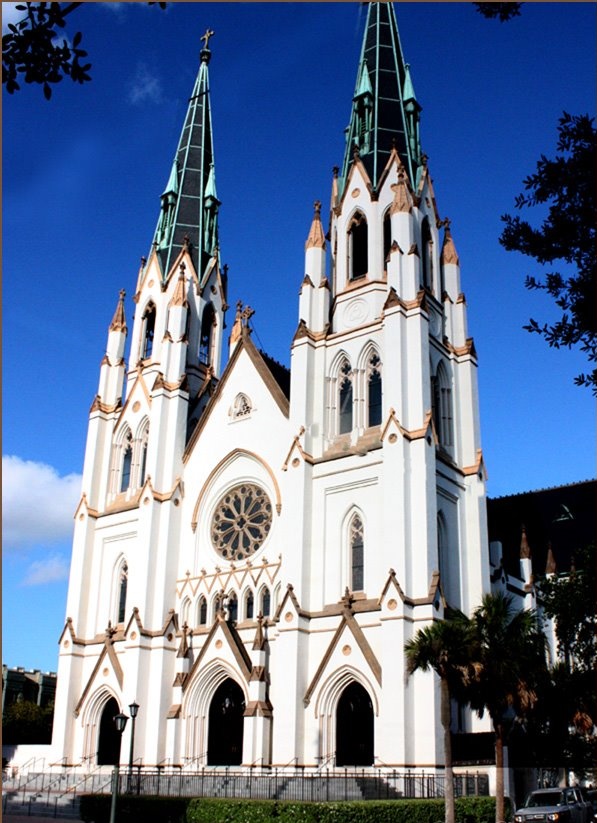
When in Savannah one of the things to do is to see the magnificent French Gothic style cathedral church in Savannah ~ John The Baptist Cathedral ~ The colonial charter of Savannah prohibited Roman Catholics from settling in Savannah. The English Trustees feared that Roman Catholics would be more loyal to the Spanish in Florida than the English. This prohibition faded shortly after the American Revolutionary War and this congregation was reorganized around 1796. French Catholic emigres established the first church in 1799 fleeing from Haiti after an uprising and fleeing the French Revolution.A second church was dedicated in 1839 due to the increase in population of Savannah Catholics. Construction began on the new Cathedral of St. John the Baptist in 1873 and was completed by the addition of the spires in 1896. It was almost totally destroyed by fire in 1898 and through diligent effort was rebuilt by 1899.


This pretty much wraps up our time in Savannah ~ but don't be sad because we will return to this fun and historic city. Tomorrow we head out for Kitty Hawk, North Carolina where we will be exploring the Outer Banks and the Wright Brothers National Memorial.
Have Fun, Travel Safe & Stay Healthy!!!


When in Savannah one of the things to do is to see the magnificent French Gothic style cathedral church in Savannah ~ John The Baptist Cathedral ~ The colonial charter of Savannah prohibited Roman Catholics from settling in Savannah. The English Trustees feared that Roman Catholics would be more loyal to the Spanish in Florida than the English. This prohibition faded shortly after the American Revolutionary War and this congregation was reorganized around 1796. French Catholic emigres established the first church in 1799 fleeing from Haiti after an uprising and fleeing the French Revolution.A second church was dedicated in 1839 due to the increase in population of Savannah Catholics. Construction began on the new Cathedral of St. John the Baptist in 1873 and was completed by the addition of the spires in 1896. It was almost totally destroyed by fire in 1898 and through diligent effort was rebuilt by 1899.


This pretty much wraps up our time in Savannah ~ but don't be sad because we will return to this fun and historic city. Tomorrow we head out for Kitty Hawk, North Carolina where we will be exploring the Outer Banks and the Wright Brothers National Memorial.
Have Fun, Travel Safe & Stay Healthy!!!


